
Does Anyone Actually Know What Your Candidates Believe?
Voter guides, the information gap, and the quiet work of fixing it

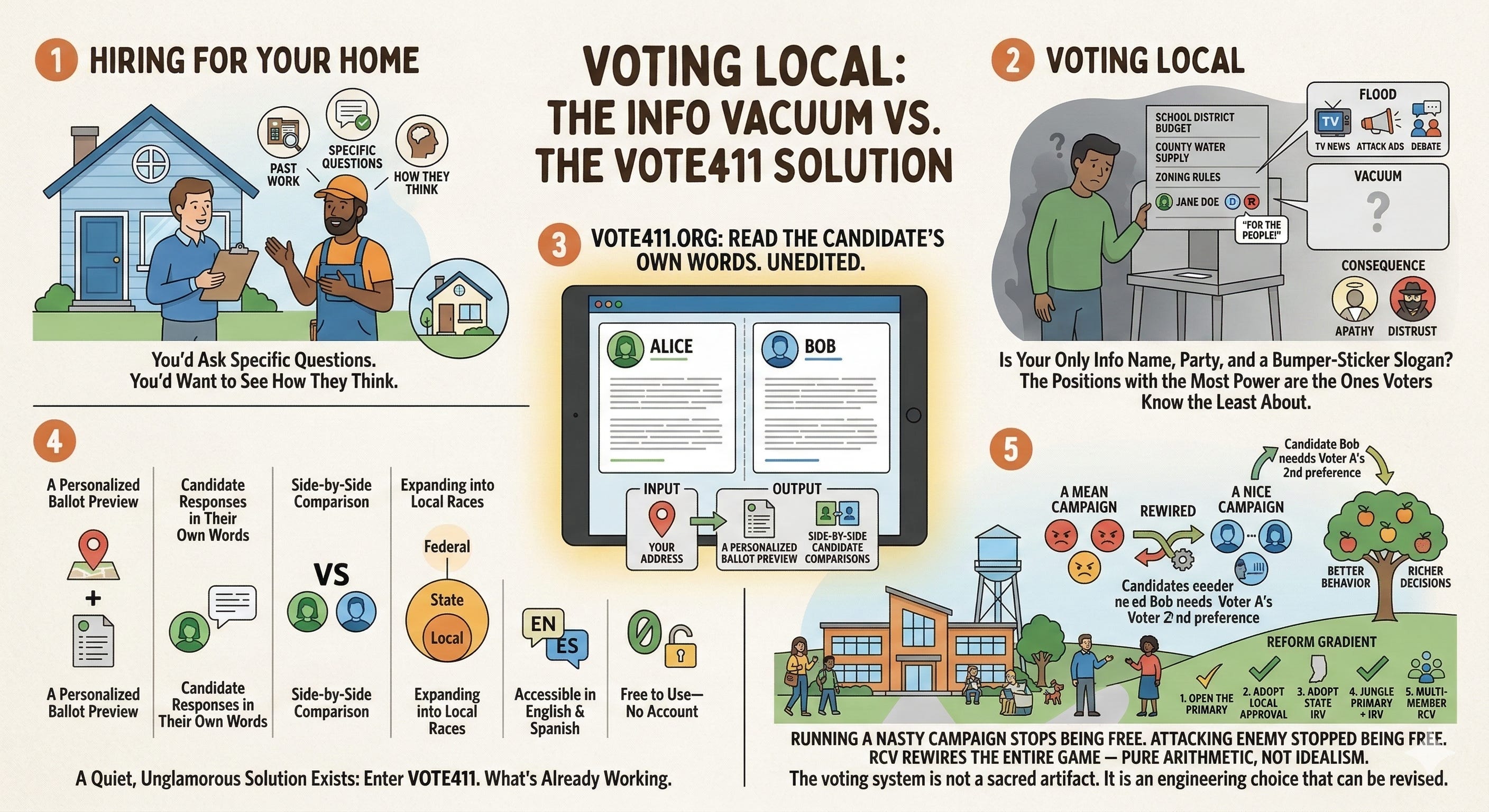
Imagine you’re hiring someone to manage your house — pay the bills, keep the roof repaired, decide which contractors to trust. You’d probably want to know what they’ve done before. You’d ask specific questions. You’d want to see how they think, not just what they say in a two-minute pitch at the front door.
Now imagine you’re voting for the person who will make decisions about your school district’s budget, your county’s water supply, or the zoning rules for your neighborhood — and the only information you have is their name, their party, and a bumper-sticker slogan.
That’s not a hypothetical. For most local elections in America, that’s the reality. And it matters more than most people realize, because local offices are where a huge portion of the decisions that affect daily life actually get made.
1. The Ballot vs. The Candidate
The way we count votes (and who votes) shapes which candidates win, but there’s a step before counting that gets less attention: how do voters learn about who they’re choosing between in the first place?
Presidential and Senate races are saturated with raw data — even if little actual information. Cable news, attack ads, debate highlights, newspaper endorsements — the challenge there isn’t finding information, it’s filtering the flood where it’s embedded. But drop down the ballot into a state legislative race, a school board seat, or a water district board, and the information environment changes completely.
These races are decided by voters who often know almost nothing about the candidates. Not because voters don’t care — but because the information simply isn’t there. Candidates for local office frequently don’t have websites. Local newspapers have shrunk or disappeared. And the positions with real power over daily life — who can build what, where your tax dollars go, how your kids get taught — are decided in an information vacuum.
Voters may assume that the parties they have always been loyal to have already done the vetting, that they wouldn’t be nominating someone that would do a bad job, but in the current environment it’s quite clear that this is a mistaken assumption. We only see the consequences when it’s already too late. The result is apathy, “all politicians are the same, only narcissists and ignorant people seek power.” If that’s our perception of politics, who exactly would be running for office? If no one can distinguish the saint from the crook, what is the point?
The positions with the most direct power over daily life are the ones voters know the least about.
2. Enter VOTE411: What’s Already Working
Here’s something worth knowing: a quiet, unglamorous solution to this problem already exists and has been running for nearly twenty years.
The League of Women Voters — one of the oldest nonpartisan civic organizations in the country — runs a platform called VOTE411.org. The idea is simple: find out what’s on your specific ballot, then read what each candidate actually said in response to standardized questions. Not what a reporter interpreted. Not what a pundit thinks. The candidate’s own words, unedited.
You enter your address. The site shows you every race on your ballot — from president down to city council. For each race, it shows you each candidate’s response to a set of questions, side by side. You can compare them directly.
What VOTE411 provides
A personalized ballot preview based on your address
Candidate responses to nonpartisan questions, in their own words
Side-by-side comparison across candidates
Information on federal, state, and an expanding range of local races
Available in English and Spanish, with screen reader support
Free to use — no account required
In 2024, VOTE411 covered over 1,800 candidates in North Dakota alone. Across the country, tens of millions of voters used it before casting their ballots. That’s a genuine public good, run on a modest nonprofit budget, by an organization that has spent over a century building the trust that makes nonpartisan information valuable.
The League’s model is strict: they don’t endorse candidates. They don’t score answers. They ask the same questions of every candidate in a race and publish exactly what each one says — including a clear note when a candidate chooses not to respond.
Knowing who didn’t answer is itself useful information.
3. What a Voter Guide Can and Can’t Tell You
VOTE411 is genuinely useful. But it’s worth being honest about what any standardized questionnaire can and can’t do — because understanding the gap is the first step toward filling it.
What questions can tell you
When a candidate responds to “What is your top priority for the school district budget?” and writes two thoughtful paragraphs about early literacy funding and after-school programs, you’ve learned something real. You’ve learned what they say they prioritize, in their own voice, in a format where all their opponents answered the same question. That’s more than you’d learn from a yard sign.
Questions are especially useful for filtering out candidates who are clearly not paying attention. If someone is running for county water commissioner and their answer to “What is the biggest water quality challenge facing this county?” is a vague paragraph about supporting clean water for all families — you’ve also learned something real. You’ve learned they either don’t know or don’t want to say.
What questions can’t always tell you
Standardized questions are less effective at revealing what a candidate can do with a problem — as opposed to what they say about it. Consider two hypothetical responses to the same question:
Question: What would you do about the aging stormwater infrastructure in our district?
Candidate A: “Flooding is a serious problem affecting our families. I will work with all stakeholders to modernize our infrastructure and protect our community.”
Candidate B: “The district’s stormwater system was built in the 1960s and is undersized for current runoff loads. Under the Clean Water State Revolving Fund, the district qualifies for low-interest federal loans that could finance Phase 1 repairs — roughly the Oak Street and Central Basin corridors — without raising property taxes in the first term. I’d begin the loan application in the first 90 days.”
Candidate A said something true and said nothing. Candidate B demonstrated that they actually understand how municipal infrastructure finance works. Same question. Completely different quality of information.
This isn’t a flaw in VOTE411’s mission — it’s an inherent limit of the questionnaire format for certain types of offices and issues. A question asks for a position. Some offices require demonstrating not just a position, but the capacity to act on it. Knowing the difference — and designing the right tool for each situation — is the challenge at the frontier of voter information.
4. The Information Voters Actually Deserve
As the previous posts in this series have pointed out: a vote is a signal. It carries information from the voter to the political system about what people want. The quality of that signal depends on what voters know when they cast it.
A voter who knows nothing about the candidates except their party affiliation is essentially voting on autopilot — not expressing their own preferences, but inheriting their party’s. That’s not wrong, exactly, but it’s a much weaker signal than a voter who has read what each candidate actually said, compared their responses side by side, discussed it with their neighbors, and noticed that Candidate B answered the infrastructure question with specific knowledge and Candidate A didn’t.
VOTE411’s mission is to make informed voting possible for every race on every ballot. That’s an ambitious goal — most organizations focus on high-profile races where the information environment already exists. The League focuses precisely on the races where it doesn’t.
The Local Races That VOTE411 Covers
School board elections determine curriculum, book policies, and teacher hiring — affecting millions of children directly. Water district boards control infrastructure worth billions. County commissioners decide zoning, permitting, and local tax rates. State legislative races shape everything from criminal law to education funding. These offices collectively exercise more direct power over most people’s lives than any federal position — and they’re the ones voters typically know least about.
5. The Accountability Loop
There’s a less obvious reason that voter guides matter beyond individual elections: they create a record.
When a candidate answers a questionnaire in 2024 and then runs again in 2028, their previous answers exist. A voter — or a journalist, or a rival campaign — can compare what they said then to what they’re saying now. Did their position change? Do they acknowledge it? Can they explain why?
This is the accountability loop: public statements, publicly archived, that candidates can be held to over time. It’s a modest but real form of transparency that costs nothing and requires only that the record be preserved.
The value compounds. A voter guide that covers one election is useful. A voter guide platform that has covered the same races across three election cycles starts to look something like a public record — a history of what candidates said they would do, and (through other public records) what they actually did. Unaddressed problems and candidate platitudes would have nowhere to hide.
The only thing more useful than knowing what a candidate says today is knowing what they said four years ago.
6. The Simplest Thing You Can Do
The case for supporting and using VOTE411 is not complicated:
It already exists. The infrastructure is built. The trust is earned.
It covers the races that the rest of the information ecosystem ignores.
It treats every candidate equally — same questions, same format, same prominence for non-responses.
It works in both English and Spanish and is accessible to screen readers.
It is genuinely free and nonpartisan.
Using it before you vote is the lowest-effort, highest-impact thing an individual voter can do to raise the quality of their vote signal. Sharing it — with neighbors, with a school group, in a group chat — multiplies that impact.
More candidates participating means more information for voters. More voters using VOTE411 means candidates have reason to participate — because they know their answer (or their non-answer) will be read. The loop closes in the right direction.
A Note on What Comes Next
This series has been building a case that expressive voting — richer ballots, better systems, more honest signals — can improve democratic representation without waiting for federal action. VOTE411 fits that argument exactly: it improves the information environment at every level of government, costs nothing to use, and is available right now.
VOTE411 is a good starting point, but we need to ask ourselves what better voter information infrastructure could look like — not replacing what VOTE411 does, but supporting their effort and extending it into dimensions it doesn’t yet cover. That’s a more complicated conversation we should be having.
For now, the simpler point: go to vote411.org before your next election. Enter your address. Read what the candidates said. Notice who didn’t answer. Talk to your neighbors about what you found. Then vote accordingly. That’s it, that’s how we start improving our democracy.
Part of the Expressive Voting series, other articles in this series:
What Your Vote Actually Does · One Ballot, Many Languages · Why Nice Campaigns Win