
What Your Vote Actually Does
Voting Systems, Democratic Noise, and Why Better Choices Are Hard to Choose

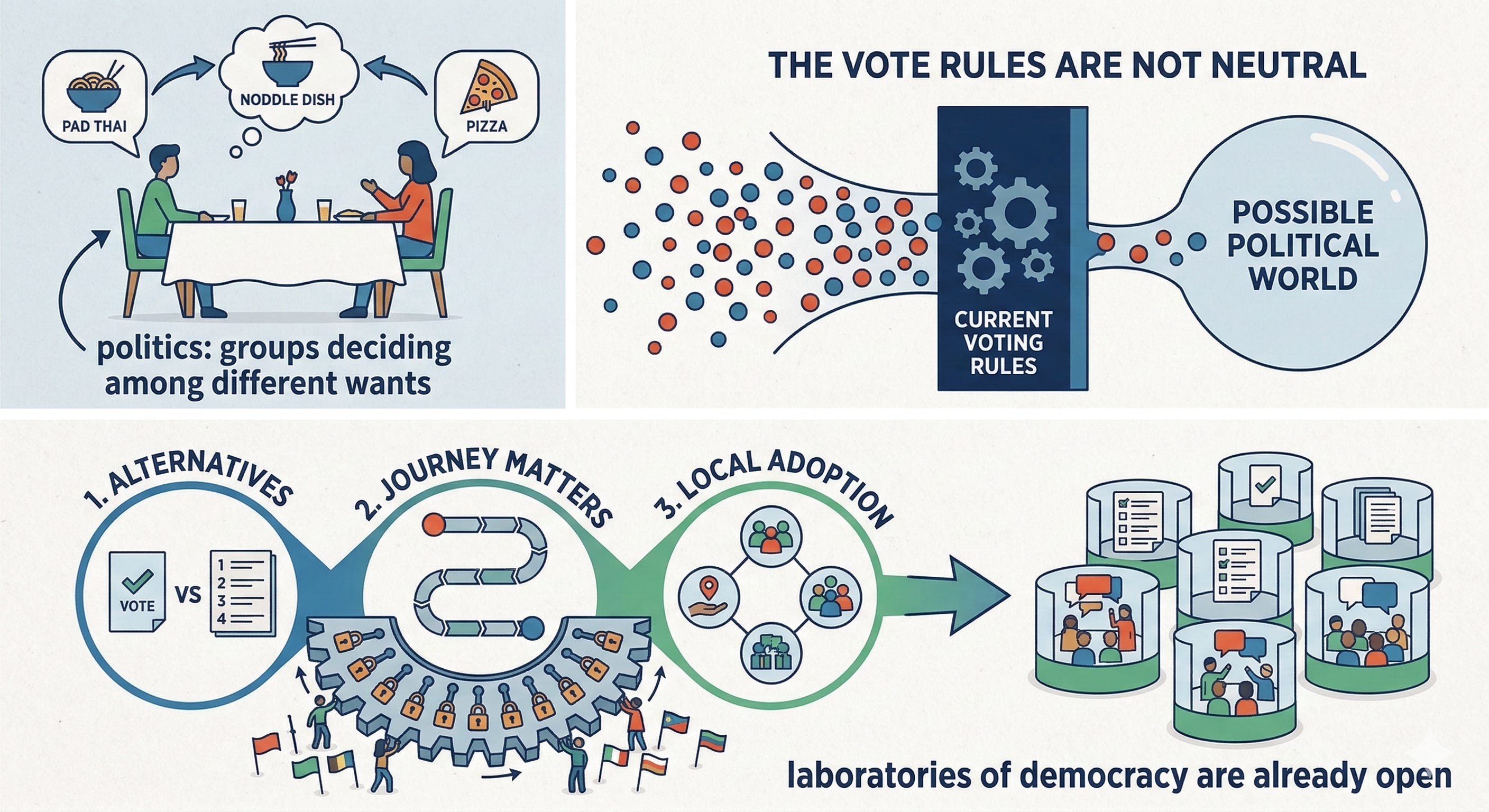
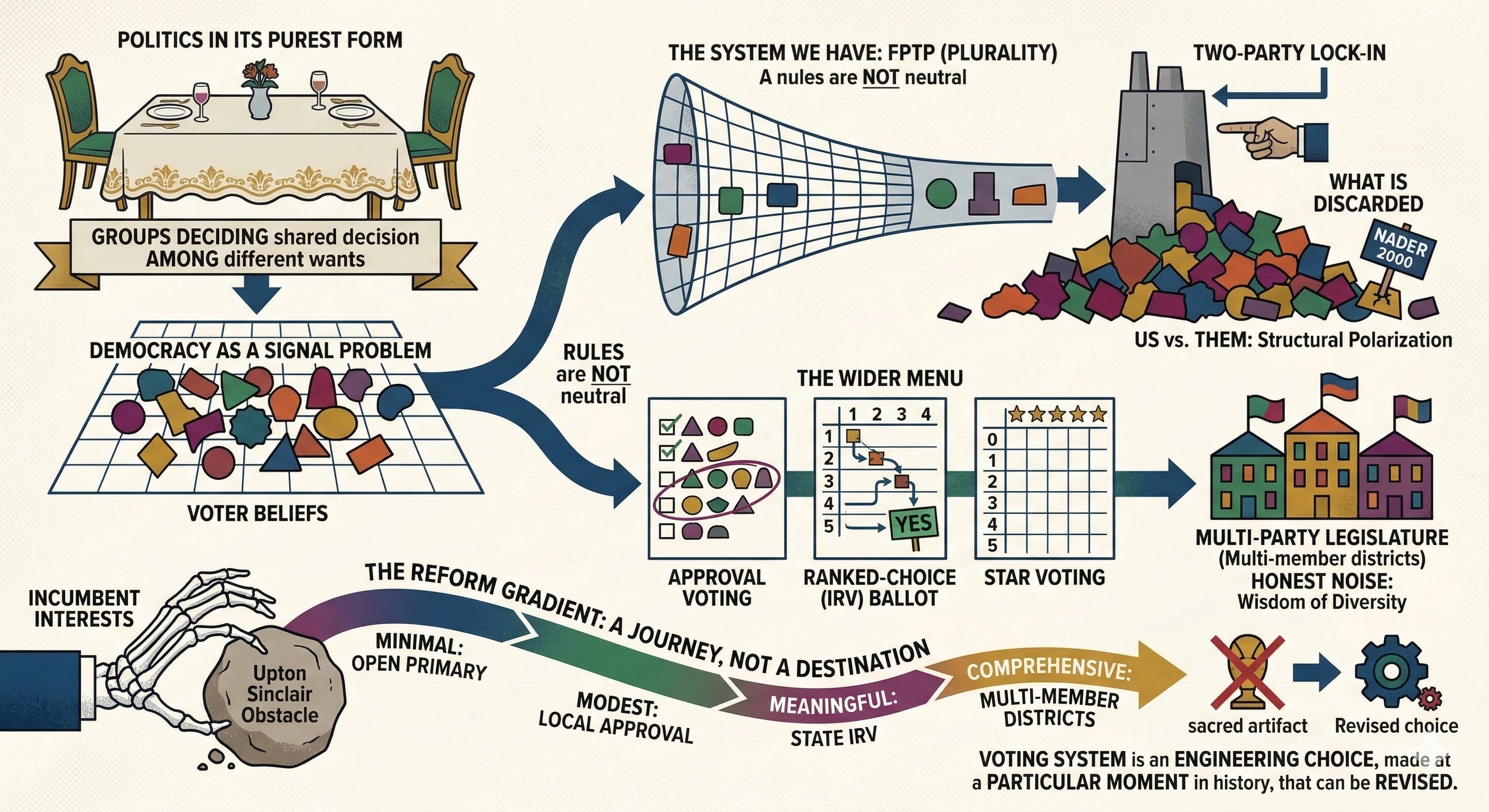
Imagine two people trying to decide where to have dinner. One wants Thai food. The other wants pizza. They’ll talk it out, maybe compromise on the Italian place that also does noodles. This is politics in its purest form: the machinery by which groups of people who want different things arrive at a shared decision.
Now multiply that dinner table by two hundred million. You have an American election.
The rules you use to count votes are not neutral. They are not mere administrative machinery that tallies preferences. They actively shape which preferences get expressed, which candidates survive, and ultimately what kind of political world is possible. A badly designed voting system doesn’t just count badly — it poisons the conversation before it starts.
This article is about why the way we vote is not neutral, what the alternatives look like, and why changing the rules turns out to be one of the hardest political problems of all. Not because the alternatives are complicated, but because the people who benefit from the current broken system are the ones who get to decide whether to fix it. It is also about something most electoral reform discussions omit: the journey matters. Better systems can be adopted incrementally, locally, and legally — without waiting for federal action and insurmountable barriers. The laboratories of democracy are already open.
1. First Past the Post: The System We Have
How It Works — and What It Discards
The current American voting system is called First Past the Post (FPTP), or plurality voting. The rule is simple: mark one candidate. Whoever gets the most marks wins, even if that is far less than a majority of voters. In a three-candidate race where the vote splits 40-35-25, the winner with 40% represents three out of five voters who actively chose someone else.
FPTP’s simplicity is real and not trivial. Counting is fast, transparent, and auditable. A child can understand the rule. For a society scaling to millions of voters without computers, it was a workable design. The problem is not that it was a bad invention for its time. The problem is that its failure modes are structural, predictable, and get worse as the electorate grows more diverse in its preferences.
Under FPTP, a vote is binary: for one person, against everyone else. Everything you actually think about politics — your relative preferences, your willingness to accept second-best outcomes, the issues you care most about — is compressed into a single mark. The translation is extraordinarily lossy.
The Founders’ Blind Spot
The architects of the American Constitution were thoughtful men with a sophisticated understanding of democratic theory. They were not naive about factionalism — James Madison devoted Federalist No. 10 specifically to the danger of factions tearing republics apart. His proposed remedy was the extended republic itself: a large, diverse nation where no single faction could dominate.
What Madison and his colleagues could not foresee was the party. Political parties, as durable, organized, ballot-controlling institutions, did not yet exist in their modern form. The Founders designed a system of individual representatives accountable to their constituents. What emerged within a generation was something they explicitly feared and failed to design against: two permanent, self-perpetuating parties that captured the machinery of elections and made themselves the gatekeepers of democratic participation.
“…My last wish is for the happiness of the homeland. If my death contributes to the end of partisanship and the consolidation of the union, I shall be lowered in peace into my grave.”
— Simón Bolívar, Final Proclamation, December 8, 1830
Bolívar, who spent his life liberating nations only to watch them fracture along partisan lines, understood from bitter experience what Madison only theorized. The party, once established, does not serve the voter. The voter serves the party. And a voting system that makes two parties mathematically inevitable has effectively handed the keys of the republic to two private organizations that answer to no constitutional authority.
2. Duverger’s Law: Why Two Parties Are a Mathematical Inevitability
The Spoiler Trap
In 1951, French political scientist Maurice Duverger formalized what political observers had long noticed: countries that use plurality voting almost inevitably produce exactly two dominant parties. Not three, not five. Two. This isn’t culture or American exceptionalism. It’s mathematics.
The mechanism runs as follows. Suppose 40% of your district prefers a moderate conservative, 35% prefer a progressive, and 25% prefer a libertarian. Under FPTP, the conservative wins with 40%. Libertarian voters now face an ugly calculation at the next election: vote their conscience, and the conservative wins again — or abandon their actual preference and vote strategically for the progressive to prevent the worst outcome. Over time, third parties stop being viable. Voters abandon them. Candidates who might represent genuine alternatives either don’t run or run only as spoilers.
The spoiler effect is not a bug. It is what FPTP does. Ralph Nader in 2000, Ross Perot in 1992, Theodore Roosevelt in 1912 — every third-party candidacy that mattered is remembered primarily as a story about which of the two dominant parties it hurt. The third-party candidate is punished not for being wrong, but for existing.
The Florida 2000 Numbers
George W. Bush beat Al Gore in Florida by 537 votes. Ralph Nader received 97,421 votes in Florida. Exit polling indicated that in a two-candidate race, Nader voters would have broken roughly 47% for Gore, 21% for Bush, with the rest abstaining.
Those voters faced a stark choice the system forced upon them: vote for their actual preference and potentially change history, or betray that preference to prevent a worse outcome. This is not an edge case. It is the system working exactly as designed — and it happens in every competitive race with more than two candidates.
The result of two-party lock-in is structural polarization. When there are only two teams, every issue becomes a team issue. You don’t form opinions on healthcare, climate, or foreign policy from scratch — you inherit them. The space of political positions, which is in reality rich and multi-dimensional, collapses into a single axis: us or them. Disagreement within the two camps is suppressed; disagreement between them is amplified into existential conflict.
Money compounds this. A candidate who cannot credibly win under FPTP cannot raise serious money. A candidate who cannot raise serious money cannot compete in the modern media environment. Name recognition becomes a proxy for legitimacy, and legitimacy is purchased. The voter who prefers none of the above is not counted as a voice — they are counted as apathy.
3. Democracy as a Signal Problem
The Lossy Translation of Political Opinion
Think about how a photograph gets printed in a newspaper. The original image is a continuous sweep of light and shadow, millions of gradations. The printing press can’t reproduce that directly — it can only put ink or not put ink at each tiny dot on the page. So it translates the continuous image into a grid of discrete dots: the finer the grid, the more faithfully the print captures the original. A coarse grid loses detail; a fine grid preserves it.
Voting does something similar. Every voter is a complex mixture of opinions — about taxes and healthcare, about immigration and foreign policy, about what kind of community they want to live in. That complexity is the original image. The ballot is the printing grid. FPTP is the coarsest possible grid: one dot, representing one candidate. Almost everything in the original image is thrown away.
More expressive voting systems — ranked choice, approval, scored voting — are finer grids. They capture more of what the voter actually thinks. The winner, when calculated from a richer data set, more closely represents the genuine center of gravity of voter opinion rather than the artifact produced by a coarse count.
When Randomness Helps: Dithering and the Wisdom of Honest Noise
Here is a counterintuitive idea from signal engineering that applies surprisingly well to voting: sometimes, adding a small amount of randomness to a coarse system actually improves the overall result. This technique, called dithering, is used in image printing, audio recording, and video compression.
In printing, if you add tiny random variations to where each dot is placed, the eye integrates them and perceives smoother gradations than the grid alone could produce. The randomness isn’t chaos — it distributes the approximation error more evenly, so no single region is systematically misrepresented. A newspaper photograph uses dithering. A crude digital image without it shows harsh banding where the gradations should be smooth.
A related effect appears in complex systems under the name stochastic resonance: in certain nonlinear systems, a small amount of noise can actually help a weak signal get through. The noise, paradoxically, helps rather than hurts. This is particularly relevant in complex systems like societies, where the artificial black and white contrasts of politics can topple governments and destroy empires.
Applied to democracy: the equivalent of dithering is genuine political diversity — multiple parties and candidates that represent different shades of opinion, some of whom win occasionally, some of whom lose, but all of whom carry real votes that reflect real preferences. A system with five viable parties is noisier in the sense of less predictable, but it is more faithful to the underlying distribution of opinion. The noise is honest. The two-party system, by contrast, produces the appearance of clarity — clean results, easy headlines — while concealing the banding artifacts beneath. It is a false smoothness purchased by discarding most of the signal.
A two-party system produces the appearance of clarity while concealing the banding artifacts beneath. It is false smoothness purchased by discarding most of the signal.
This is the deeper argument for multi-party systems. Not that five parties are administratively tidy — they are not — but that five parties more faithfully represent the actual distribution of opinion in a complex society. A legislature that contains a genuine range of positions, including small parties that must negotiate and build coalitions to govern, is noisier to manage but closer to the truth of what the electorate actually believes. Parliamentary systems in Europe and elsewhere have lived this reality for over a century. Their coalition governments are messier than American ones. They are also more responsive, because the parties that comprise them cannot afford to ignore their voters.
4. The Ranking Solution — Ballot vs. Algorithm
Two Things That Travel Together
The most common proposed solution to the spoiler effect is ranked-choice voting. Instead of marking one name, you rank candidates in order of preference: 1st, 2nd, 3rd. If your favorite can’t win, your vote transfers to your next choice rather than being discarded. You can vote for whom you actually prefer without fear of handing victory to your worst option.
Something important often gets lost in the political debate: ranked-choice voting is actually two separate things.
The first is the ballot — the act of expressing ranked preferences. This is intuitive. You make a list. You do this every time you decide what to order when your first choice might be unavailable, or when you rank job offers, or college applications. Ranking is a native human activity requiring no special training.
The second is the tallying algorithm — the method used to convert rankings into a winner. The most common method is Instant Runoff Voting (IRV): count first-choice votes; if no one has a majority, eliminate the last-place candidate and redistribute their votes to the next choice on each ballot; repeat until someone has a majority. This is more complex than ‘highest number wins’ — but it is also the part voters never have to perform themselves, any more than they need to understand the cryptography behind an ATM to withdraw cash.
Critics who say ‘ranked choice is too complicated’ are almost always conflating the ballot (simple) with the algorithm (complex but invisible to the voter). The honest response to this objection is to separate them clearly, and to note that we already accept considerable algorithmic complexity in other civic systems — tax calculations, electoral college math, redistricting formulas — without requiring citizens to manually verify them.
IRV vs. FPTP: A Fair Comparison
Before examining IRV’s limitations, it is worth being precise about what it is being compared to. FPTP has significant, well-documented failures of its own. Any honest assessment must hold both systems to the same standard.
FPTP vs. IRV: The Honest Scorecard
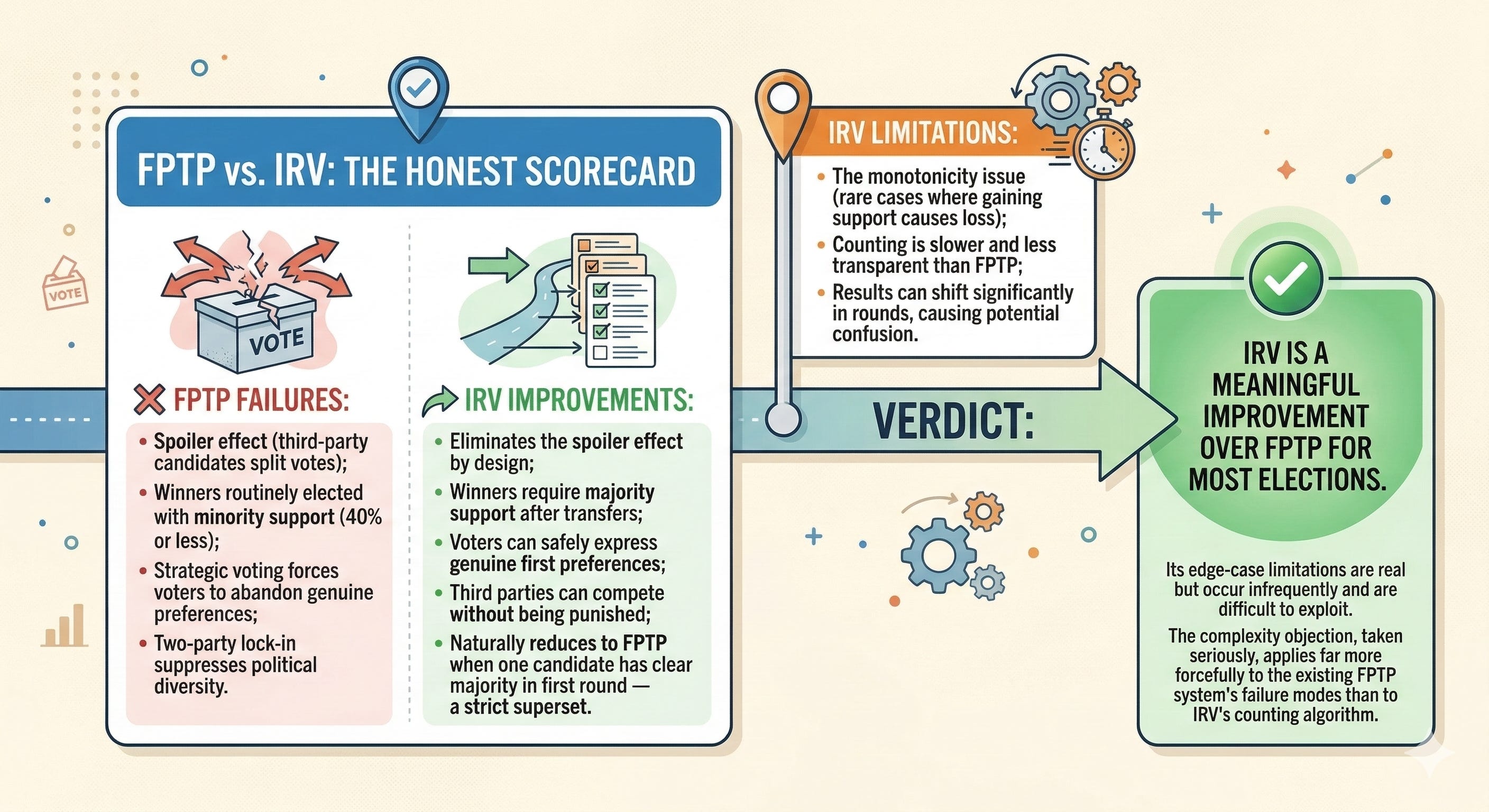
FPTP FAILURES: Spoiler effect (third-party candidates split votes); winners routinely elected with minority support (40% or less); strategic voting forces voters to abandon genuine preferences; two-party lock-in suppresses political diversity; primary elections dominated by ideological extremes.
IRV IMPROVEMENTS: Eliminates the spoiler effect by design; winners require majority support after transfers; voters can safely express genuine first preferences; third parties can compete without being punished for existing; naturally reduces to FPTP when one candidate has a clear majority in the first round — making it a strict superset of the existing system.
IRV LIMITATIONS: The monotonicity issue (in rare cases, gaining support can cause a candidate to lose); counting is slower and less transparent than FPTP; results can shift significantly as ballots are counted in rounds, causing confusion before final tallies are in.
VERDICT: IRV is a meaningful improvement over FPTP for most elections. Its edge-case limitations are real but occur infrequently and are difficult to exploit. The complexity objection, taken seriously, applies far more forcefully to the existing FPTP system’s failure modes than to IRV’s counting algorithm.
Alaska’s 2022 experience is instructive. In the special election for its at-large Congressional seat, Sarah Palin (prominent independent-leaning Republican), Nick Begich (mainstream Republican), and Mary Peltola (Democrat) ran under IRV. Republican voters could safely rank both Republican candidates without fear of spoiler effects — something FPTP would never have permitted. The result accurately reflected Alaskans’ preferences rather than being an artifact of vote-splitting geometry.
Maine adopted IRV for federal elections in 2016, making it the first state to do so. Multiple legal challenges have been mounted and survived. The system has now run through several election cycles without the catastrophic complexity failures its opponents predicted.
Reporting RCV Results: The Complexity That Can Be Managed
FairVote and the Ranked Choice Voting Resource Center have identified that much of the perceived complexity of IRV comes not from the system itself but from how results are reported. Their best-practices guidance recommends releasing a preliminary round-by-round tally on election night — showing voters not just who won but how the count evolved — and publishing the full ballot record so anyone can verify the result independently.
The key insight is that transparency in reporting makes the algorithm legible, and legibility defuses the complexity objection. When voters can see that their second-choice vote transferred to their next preference exactly as promised, the system feels trustworthy rather than mysterious. Salt Lake County, Utah has pioneered this approach, linking from its official results page to interactive visualizations that let voters explore the round-by-round count themselves. The tool used — RCVis.com — is free and works from standard exported ballot data.
5. The Wider Menu: Approval, STAR, and the Open Primary
Approval Voting: The Simplest Upgrade
If even ranked ballots feel like too much change, there is a simpler alternative: approval voting. Mark every candidate you find acceptable. No ranking, no elimination rounds. Just check all the boxes you like. The candidate approved by the most voters wins.
Fargo, North Dakota adopted approval voting in 2018 — the first American city to do so. Saint Louis, Missouri followed in 2020. The results have been consistently drama-free: more candidates ran, voters felt less strategic pressure, and winners tended to be broadly acceptable rather than intensely preferred by a narrow plurality.
Approval voting captures something important: instead of forcing you to pick one point in political space, it lets you draw a circle around the region you find acceptable. The winner is the candidate whose position falls inside the most voters’ circles. This is closer to how real democratic legitimacy works — not the person most intensely preferred by a plurality, but the person most broadly acceptable across the electorate.
STAR Voting: Scoring the Spectrum
Score-then-Automatic-Runoff (STAR) voting goes further. Score each candidate from zero to five stars. Sum all scores. The two highest-scoring candidates advance to an automatic runoff, where the candidate preferred by more voters wins.
STAR combines the expressive richness of score voting — degrees of preference, not just yes/no — with a runoff that ensures majority support over the runner-up. It is arguably the most information-rich of the widely discussed systems.
There is, however, a real obstacle.
The Legal Wall: When Better Systems Hit Constitutional Language
In Oregon, a STAR voting initiative qualified for the 2024 ballot in Multnomah County and was challenged in court. The argument was not that STAR was unfair but that state election law requires a ‘plurality’ or ‘majority’ winner — and STAR’s two-stage scoring process was argued to be incompatible with that language. This is a pattern reformers encounter repeatedly: better systems can conflict with constitutional language written before those systems were invented.
Courts interpreting nineteenth-century language may rule that any scoring or multi-step process does not satisfy the constitutional standard — even if it more accurately reflects voter preferences. STAR voting may require state constitutional amendments in many jurisdictions. That is a much higher bar than a statutory change.
This is not an argument against STAR voting. It is an argument for understanding the legal landscape before designing a reform strategy. Approval voting and IRV have both withstood legal challenge in multiple jurisdictions. STAR and other scoring systems are still navigating that terrain.
The Open Primary and the Jungle
A complementary reform operating on the primary rather than the general election is the open primary — or in its most radical form, the jungle primary. Instead of parties selecting nominees in separate, party-controlled primaries, all candidates appear on a single ballot open to all voters. The top vote-getters — regardless of party — advance to the general election.
California and Washington state use jungle primaries. Louisiana has long used a variant: all candidates appear on the same November ballot, with a runoff between the top two if no one achieves a majority — a system that predates California’s adoption and has operated in a Southern context with its own distinct dynamics.
The intent is to reduce the grip of party primaries, which are typically won by ideologically extreme candidates because only the most motivated partisans bother to vote in them. Party primaries have produced a generation of representatives who are more extreme than their districts because the effective election happened in a low-turnout contest where the passionate minority drowned out the moderate majority.
Open primaries force candidates to appeal to the broader electorate from the beginning. In jurisdictions with jungle primaries, the most important effect has often been the emergence of two candidates from the same party in the general election — forcing a genuinely intra-party choice before the public, rather than leaving it to the party machine.
The Conflict Between Party and Voting System
Jungle primaries expose a tension that exists in all electoral reform: the voting system and the party system operate simultaneously, and they can work against each other.
In California’s jungle primary, both major parties have adapted by coordinating to avoid splitting their vote in the primary — endorsing one candidate early to prevent two of their own from advancing. This is rational party behavior. It is also exactly the kind of gamesmanship that electoral reform is supposed to reduce.
The conflict between party interests and voting system design is not resolved by any single reform. It requires both: a voting system that makes gaming harder, and party reform that aligns party incentives with voter interests rather than incumbent protection.
★ The Author’s Preferred Architecture
My preferred architecture begins at the primary stage with approval voting in an open jungle primary — all candidates, all voters, check every candidate you find acceptable.
Approval voting in the primary eliminates strategic vote-splitting from the first round. The candidates who emerge are those with the broadest genuine support across the electorate, not those who successfully consolidated a narrow partisan base.
The threshold condition: the advancing candidates should collectively represent the approval of at least 75% of voters who participated — ensuring the field reflects genuine majority opinion before the general election begins.
This is not a radical proposal. Approval voting is already in use in American cities. Open primaries are in use in major states. The combination is a natural extension of experiments already underway.
6. The Geography of Opinion: Districts and the Representation Problem
Candidates Choosing Their Voters
Even a perfectly designed ballot produces distorted results when the districts are wrong. In the United States, congressional and state legislative seats are allocated through single-member districts: each geographic area sends exactly one representative, and the winner takes everything. The 49% who voted for someone else are represented by a person they opposed.
Single-member districts create the structural precondition for gerrymandering — the drawing of district boundaries to predetermine electoral outcomes. In competitive, information-rich districts, whoever controls the mapmaking controls the results. The process has evolved from a rough partisan art into a precision science, aided by demographic data and computational optimization.
The effect is one of the most profound inversions in democratic theory: candidates effectively choose their voters rather than voters choosing their candidates. A legislator whose district has been carefully engineered for safety does not need to represent the median opinion in their geographic area. They need to satisfy the ideological requirements of the primary electorate that controls their renomination. That is a very different incentive structure, and it produces very different behavior.
Multi-Member Districts: The Geometric Fix
The structural solution to gerrymandering is straightforward in principle and politically explosive to implement: multi-member districts, where each geographic area elects three, five, or seven representatives proportionally.
In a five-member district, a 55% majority takes three seats and the 45% minority takes two. Both are represented. More importantly, engineering a gerrymander becomes nearly impossible: to deny the opposition any representation, you would need to manufacture supermajorities across broad geographic areas. The manipulability of the system is roughly proportional to the ratio of seats to boundaries — fewer boundaries means less to manipulate.
Ireland, Malta, Scotland, and the Australian Senate all use multi-member districts with ranked choice voting. Their parliaments more closely mirror the distribution of opinion in their populations. A party with 15% support gets roughly 15% of seats rather than zero.
The Border Problem: NIMBY and Diffuse Districts
Multi-member districts do not solve everything. One persistent challenge is geographic: communities near the boundary between two districts may find that their most pressing local issues — a proposed highway, a school boundary, a zoning change — fall between the jurisdictions of representatives whose constituencies extend in different directions. This is the electoral version of the NIMBY problem.
One approach that has been explored theoretically is what might be called diffuse border districts — boundaries that are not sharp lines but probabilistic zones, where voters in a border region are assigned to districts by a controlled random process that reflects their geographic position. This preserves proportional representation while reducing the cliff-edge effects at district boundaries. It is mathematically more complex than fixed districts, but no more complex than systems already in routine use in allocation problems across governments.
The point is not that diffuse districts must be implemented immediately. The point is that the problem has solutions beyond the current binary choice between gerrymandered single-member districts and rigidly bounded multi-member ones. The space of possible district designs is much larger than current political imagination occupies.
Parliamentary Systems: The Comparison That Matters
Much of what American electoral reformers propose has been operating successfully in parliamentary democracies for decades. The objection that ‘coalition governments are unstable’ deserves a direct answer.
Germany’s proportional representation system has produced stable, long-term governments for seventy years. Sweden, Denmark, and the Netherlands — all multi-party proportional systems — consistently rank among the world’s highest in governance quality and citizen satisfaction.
The mechanism: in a multi-party system, parties must negotiate to form governing coalitions, which forces compromise and forces each party to remain responsive to the voters who elected it. A party that ignores its voters loses them to a competitor — something impossible under two-party FPTP, where voters have no alternative destination.
The American objection to coalition complexity would be stronger if the two-party system were actually producing coherent, effective governance. The empirical record of the last thirty years does not obviously support that claim.
★ The Author’s Preferred Architecture
The second stage of my preferred architecture: a multi-member district general election using ranked-choice voting.
Districts of three to seven members. Candidates advance from the approval-voting jungle primary. Voters rank remaining candidates in order of preference. Seats are allocated proportionally using ranked-choice tabulation.
The target: a legislature where three to five genuine political perspectives are represented, each carrying real seats proportional to their actual support. Not the false clarity of two teams, but the honest complexity of a society with more than two views.
Why this number? Three to five parties is the zone where coalition-building is required but not chaotic — where no single faction can govern alone, but government remains possible without endless fragmentation. The Nordic countries have operated this way for generations.
7. The Real Objections — and the Real Obstacle
Complexity: Separating the Ballot from the Algorithm
The complexity objection deserves honest engagement. IRV counting is genuinely less transparent than FPTP counting. Understanding why a candidate won the first round but lost the election requires explaining the transfer process to voters who may be encountering it for the first time. This is a real cost of adoption, not an invented problem.
The honest response has three parts. First, separate the ballot from the algorithm. Ranking candidates is something every voter can do — we rank our preferences constantly in daily life. The complexity lives in the counting method, which voters don’t perform; they observe the result.
Second, reporting practices matter enormously. FairVote’s research on jurisdictions that have adopted ranked choice voting shows that when election officials release round-by-round tallies on election night — showing how each round changed the count — voter confusion drops dramatically. The tool RCVis.com generates clear visual representations of the counting process from standard ballot data, free of charge. Complexity is often a reporting problem masquerading as a system problem.
Third, research on voter experience consistently shows that self-reported difficulty of ranked-choice ballots is lower than critics predict. In New York City’s 2021 ranked-choice primary, over 90% of voters across every demographic group reported finding the ballot simple to complete. Turnout was the highest in a city primary in thirty years.
Voter Motivation: Does Complexity Suppress Participation?
The concern that complex systems suppress turnout is empirically testable, and the evidence consistently points in the opposite direction: where ranked choice voting has been adopted, turnout in previously low-participation primaries tends to increase, not decrease. The intuition is straightforward — when your vote is more expressive, it feels more worth casting.
The Real Obstacle: The Upton Sinclair Problem
If complexity is manageable and turnout concerns are not supported by evidence, why doesn’t reform happen more easily? The answer was expressed most precisely not by a political scientist but by a novelist.
“It is difficult to get a man to understand something when his salary depends on his not understanding it.”
— Upton Sinclair
Both major American political parties have profound structural interests in preserving the two-party system. The Democratic Party and Republican Party exist in their current forms because they have no viable competition. A voting system that enabled a genuine third or fourth party would not merely change who wins elections. It would potentially dissolve the existing party structures entirely.
This is why electoral reform in the United States almost always comes through ballot initiatives — citizen-driven processes that bypass the legislature — rather than through legislative action. California’s jungle primary came from a ballot initiative. Alaska’s ranked choice voting came from a ballot initiative. Maine’s ranked choice voting came from a ballot initiative, survived legislative repeal attempts, and was reaffirmed by voters. The legislature did not choose these reforms; the voters did, over the legislature’s sustained objection.
The deepest irony in electoral reform: the system that most needs to be changed is the one that decides whether it gets changed.
8. The Reform Gradient: A Journey, Not a Destination
The Laboratories of Democracy
One of the most under-appreciated features of American federalism is that it makes electoral experimentation not just possible but legally routine. States and localities can adopt new voting systems by referendum, statute, or charter amendment without any federal action whatsoever. The federal government sets almost no requirements about how state and local elections are conducted, beyond guaranteeing equal protection and prohibiting discrimination.
This means that a city of fifty thousand people can adopt approval voting for its mayoral race without asking anyone’s permission. A county can adopt IRV for its commissioner elections. A state can adopt a jungle primary for its legislative races. All of these have happened. All of them are currently running, generating real data, building public familiarity, and — crucially — defusing the complexity objection with lived experience rather than theoretical argument.
Every city that runs a successful ranked-choice election becomes evidence. Every county that adopts approval voting and finds its races less acrimonious builds the case for the next jurisdiction. This is how reform travels in a federal system — not from the top down as a single national policy, but bottom-up as a distributed experiment, the most successful versions of which eventually attract broader adoption.
The Data Dividend: Better Systems Produce Better Data
There is a further argument for adopting richer voting systems that rarely appears in reform advocacy: the data they generate enables academic progress that plurality voting cannot.
When voters rank candidates, that ranking data is a rich record of the actual shape of political preference in a population. Researchers can use it to test different tallying algorithms, compare outcomes under IRV vs. Condorcet vs. STAR on the same ballots, study how political coalitions actually form, and identify the real distribution of opinion that FPTP suppresses into invisibility.
Political scientists, statisticians, pundits, NGOs, and representatives can use it as hard data for voter preferences. Using the candidates as a system of coordinates, a proxy for the preferences of a society, can lead to much more nuanced and valuable data for anyone involved in politics and representation than any limited poll could.
This data feedback loop is one of the most important arguments for moving incrementally. You don’t need to design the perfect system before beginning. You adopt a richer ballot, collect the data, publish it, let the academic community analyze it, and use the findings to inform the next generation of improvements. Legal constraints will also evolve as courts engage with new systems — what is constitutionally uncertain today may be well-established in a decade.
Electoral reform is not a switch that is thrown once. It is an iterative engineering process. The goal is not to arrive at the final answer immediately; it is to move steadily in the direction of capturing more signal, and to build the evidence base that makes each subsequent step politically viable.
The Reform Gradient — From Here to There
MINIMAL: Open the party primary. Allow all registered voters to participate in primary elections regardless of party affiliation. No ballot changes required. Reduces ideological extremism in nominees without touching the general election system. Available by statute in most states.
MODEST: Adopt approval voting for local elections. Cities and counties can do this by charter amendment. Simple to explain, legally uncontroversial, immediately reduces spoiler effects in multi-candidate local races. Building block for larger change.
MEANINGFUL: Adopt IRV for state and local elections via ballot initiative. The ballot feels natural; the counting is transparent with proper reporting tools. Well-precedented legally. Eliminates spoiler effects and enables genuine third-party competition.
SUBSTANTIAL: Jungle primary with IRV general. All candidates on one primary ballot; top finishers advance to IRV general election. Removes party gatekeeping while maintaining familiar majority-preference logic in the final round.
COMPREHENSIVE: Multi-member districts with proportional ranked-choice voting. Requires redistricting reform and likely state constitutional amendment. Maximally resistant to gerrymandering; produces legislature proportional to actual voter opinion.
The author’s preferred architecture — approval voting jungle primary, top-four advancing, multi-member district ranked-choice final — sits between the Substantial and Comprehensive levels. It can be implemented piecemeal: the primary reform first, followed by district reform as political conditions allow.
★ The Author’s Preferred Architecture
The full architecture assembled: an approval-voting open jungle primary, from which the top candidates collectively approved by 75% or more of voters advance; followed by a multi-member district general election using ranked-choice voting; with three to seven seats per district to ensure proportional representation.
What this produces: a legislature where three to five distinct political perspectives hold real seats proportional to actual voter support; where no single faction can govern without building coalitions; where the primary cannot be captured by an ideologically extreme minority; and where gerrymandering is structurally difficult because the district size dilutes the value of any single boundary manipulation.
What this does not produce: a perfect system. No system is perfect. It produces a system that discards less of the signal voters are trying to send — a system whose outputs more closely reflect the actual distribution of opinion in the electorate, and whose incentive structure rewards genuine representation over partisan consolidation.
The journey matters as much as the destination. Each step toward this architecture — any open primary, any ranked ballot, any multi-member district — is an improvement over the current system. The goal is directional movement, not immediate arrival.
Conclusion: The Dinner Table, Revisited
Two people trying to decide where to eat dinner will, if they’re reasonable, find a way to account for both preferences. They might take turns. They might score options. They will not hold a vote and tell the loser their preference didn’t count. They will not design the decision process to guarantee one person always wins.
Democracy at scale cannot be a dinner conversation. But it can be designed to capture more of what people actually want, rather than forcing them to choose between honesty and effectiveness every time they enter a voting booth.
The current American system was designed for a world without computers, without instant communication, and without the modern political party as a permanent, ballot-controlling institution. The Founders were remarkably sophisticated — but they could not foresee what they could not yet see. The party was an invention that arrived after the Constitution was ratified, and the Constitution has no defense against it.
The good news is that the defense exists and is being built, piece by piece, in cities and counties and states across the country. Every ranked-choice election that runs smoothly is evidence. Every open primary that produces a less extreme nominee is a data point. Every multi-member district that eliminates a gerrymander is a proof of concept.
The voting system is not a sacred artifact. It is an engineering choice, made at a particular moment in history, that can be revised as better designs become available and as the political will to implement them is assembled, jurisdiction by jurisdiction.
The game should be worth playing for its own sake. The rules should be worth understanding — not because you have to, but because they are the grammar of your participation in the collective life of your community. And those rules, when they work well, should make your voice count for what you actually meant it to say.
Further Reading and Resources
Organizations and Active Research
FairVote — Tracks ranked choice voting adoption, maintains research on electoral outcomes, and publishes best-practices guides for election administrators and journalists. fairvote.org
RCV Best Practices Report (2024) — FairVote and the RCV Resource Center’s guide to releasing results in a way that builds voter confidence. fairvote.org/report/best-practices-for-rcv-results-2024
Center for Election Science — Research and advocacy focused specifically on approval voting. electionscience.org
RCVis.com — Free tool for generating visual round-by-round displays of ranked-choice election results. Used by official election offices. rcvis.com
Equal Systems Project / STAR Voting — The primary advocacy organization for Score-then-Automatic-Runoff voting. starvoting.org
Electoral Reform Society (UK) — Broader international perspective on proportional representation and multi-member districts. ers.org.uk
Sightline Institute — Detailed coverage of RCV implementation in Pacific Northwest states, including Portland’s 2024 multi-winner elections. sightline.org
Books
William Poundstone, Gaming the Vote (2008) — Accessible history of voting theory and reform attempts in the United States; essential background on why FPTP persists despite its failures.
Arend Lijphart, Patterns of Democracy (1999, updated 2012) — Systematic comparison of majoritarian vs. consensus democracies across 36 countries; the empirical case for proportional systems.
Frances Moore Lappé and Paul Martin Du Bois, The Quickening of America (1994) — Examines the relationship between democratic participation and system design; useful context for why ballot design affects civic engagement.
Academic and Technical Reference
Arrow’s Impossibility Theorem (Kenneth Arrow, 1951) — The foundational mathematical proof that no ranked voting system can simultaneously satisfy all reasonable fairness criteria. Understanding this theorem clarifies why every voting system involves trade-offs — and why the goal is not perfection but improvement. Wikipedia link.
Alaska Division of Elections — Detailed round-by-round data from the 2022 special and general elections under IRV. A clean real-world data set for understanding how transfers work in practice. elections.alaska.gov