
Why Nice Campaigns Win
The hidden payoff of expressive voting: when ballots carry more information, politicians have to be better people

Here is something most people sense but can rarely explain: political campaigns have gotten meaner. The attack ads are more personal. The rhetoric is more extreme. Candidates seem less interested in persuading the middle and more focused on firing up their most loyal — and most angry — supporters.
This didn’t happen by accident. It happened because the voting system rewards it.
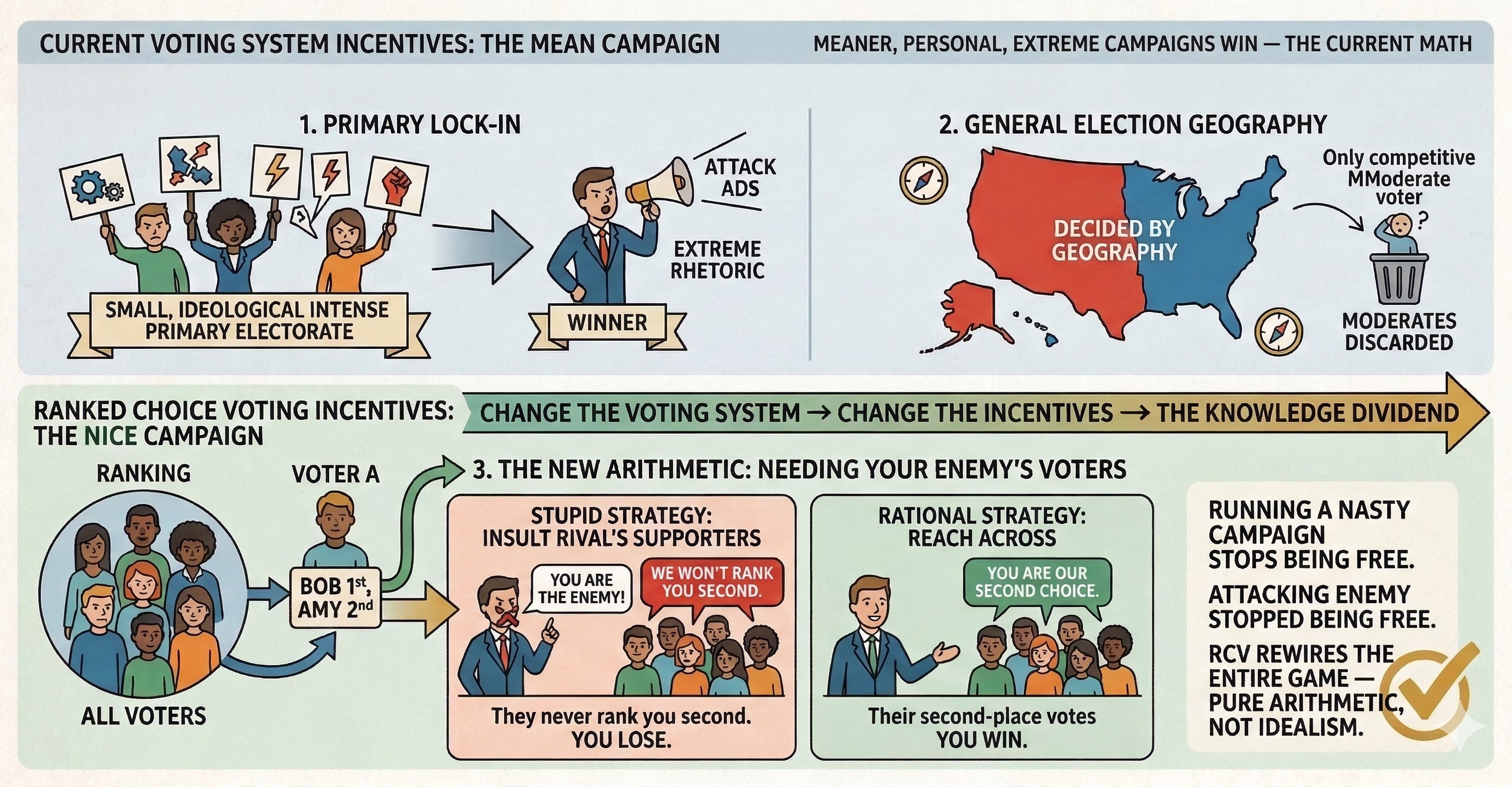
Under our current rules, if you are running in a party primary, you only need to excite the small slice of voters who show up to vote in that primary — typically the most ideologically intense members of your party. Moderate, persuadable voters barely factor in. Once you win the primary, the general election in most districts is already decided by geography and party registration. So the rational strategy is never to reach across the aisle. It is to make the other side look like a threat worth turning out to defeat.
Change the voting system, and you change the math. Change the math, and you change the behavior. This is what political scientists call an incentive structure — and it turns out that expressive ballots, ones that let voters say more than just one name, quietly rewire the incentives that candidates face. The result, still unfolding and imperfect, is something you might call the knowledge dividend: a side effect of richer voting that goes beyond who wins, and begins to change how candidates have to act in order to win at all.
1. The Logic of Needing Your Enemy’s Voters
Imagine you are running for office under ranked choice voting. Voters can rank multiple candidates — you first, someone else second. That means voters who prefer your main rival might still put you second. Those second-place votes could decide the election.
Now ask yourself: what is the stupidest thing you could do?
Attack your rival’s supporters. Call them dangerous. Make them feel that anyone who likes your rival is the enemy. Because if you do, they will never put you second. And in a close race, you just handed victory to someone else.
This is the core logic of expressive voting’s effect on campaign behavior. It is not complicated. It is not idealistic. It is pure arithmetic. When you need votes from people who don’t already agree with you, insulting them is expensive. Running a nasty campaign stops being free.
Under regular winner-take-all voting, none of this applies. Your opponent’s voters are not a resource — they are the enemy. Suppressing their enthusiasm costs you nothing. Motivating your own base through fear and anger is effective and cheap. The incentives point directly toward division.
When you need your opponent’s voters to rank you second, attacking them stops being free. That one change rewires the entire game.
2. Alaska: The Experiment That Actually Ran
In 2020, Alaska voters approved a new system: an open primary where all candidates appear on one ballot, with the top four advancing to a ranked-choice general election. The first full cycle ran in 2022. What happened next was unusual enough that researchers took notice.
Alaska 2022: Candidates Endorsing Each Other
In the race for Alaska’s single congressional seat, Democrat Mary Peltola and moderate Republican Senator Lisa Murkowski did something that would have been unthinkable in a standard campaign: they publicly encouraged their own supporters to rank the other candidate.
Murkowski told her voters: rank me first, Peltola second. Peltola’s campaign made similar cross-endorsements. Two politicians from opposite parties were, in effect, sharing voters — because the math of ranked choice made that rational.
Both won their races. Both are considered moderates. Both survived challenges from more extreme candidates within their own parties. The system had produced exactly the cross-partisan coalition-building its designers had hoped for.
Research published after the election found that Alaska’s system was ‘associated with more ideologically moderate candidates winning elections’ — a measured, peer-reviewed finding, not a talking point.
The Murkowski story is particularly striking. She had been challenged by a Trump-backed candidate in the primary. Under the old closed primary system, she might have lost — the most motivated Republican primary voters were not her fans. Under the open top-four system, moderate Republicans, independents, and even some Democrats could vote for her in the primary. She survived, and went on to win the general election with broad cross-partisan support.
This is the knowledge dividend at work. The richer ballot — one that let voters express nuanced preferences rather than forced party loyalty — produced a different kind of winner. Not necessarily the most popular within one party, but the most broadly acceptable across the full electorate.
3. New York City: Rivals Campaigning Together
In the 2021 New York City Democratic mayoral primary — one of the largest ranked choice elections ever held in the United States — something visually striking happened. Two rival candidates, Andrew Yang and Kathryn Garcia, appeared together at a public event and handed out flyers with both their faces side by side. Yang explicitly told his supporters: rank Garcia second.
Think about what this means in practice. These were competitors for the same job. In a normal campaign, they would be doing everything possible to make each other look unqualified. Instead, they were cooperating — because Yang knew his path to winning might run through Garcia’s voters, and building goodwill toward her was worth more than attacking her.
Turnout in that primary was the highest in a New York City primary election in over thirty years. Over 90% of voters across every demographic group reported finding the ranked-choice ballot simple to complete. The campaign, while competitive, was widely noted to be less personally vicious than typical New York City political races.
Not everything was perfect — eventual winner Eric Adams told his supporters to only rank him, which research later showed reduced the number of people who used their full rankings. Even in a ranked-choice race, a frontrunner can choose the old playbook. But the fact that multiple candidates were visibly competing for second-place votes — building bridges rather than burning them — represented a genuine shift in campaign behavior.
4. Maine: A More Complicated Picture
Maine was the first state to use ranked choice voting in federal elections, starting in 2018. The results there were less uniformly positive — and being honest about that matters.
⚠ What the Evidence Actually Shows
An MIT researcher analyzing Maine’s 2018 election found that negative campaign spending actually increased after RCV was adopted. Independent expenditure groups — political action committees running attack ads — spent significantly more than before.
A sentiment analysis of Facebook advertising during the same race found that the 2018 campaign in Maine’s 2nd Congressional District was more negative than comparable districts around the country that used regular voting.
The honest interpretation: ranked choice voting changes the incentives for the candidates themselves, but it does not automatically change the behavior of outside spending groups, which operate under different rules and with different goals — often simply mobilizing the base of one party against the other.
This is an important distinction. RCV nudges candidates toward civility. It does not automatically clean up the broader campaign ecosystem — which is increasingly controlled by outside money rather than candidates directly.
Maine also demonstrated something encouraging: voters adapted quickly and liked what they found. A majority of Maine voters reported expecting their first ranked-choice experience to be either ‘excellent’ or ‘good’ before the election, and post-election surveys showed satisfaction with the process. The system has been used in Maine through multiple election cycles since 2018 without the collapse in voter understanding that critics predicted.
The lesson from Maine is nuanced: ranked choice voting shifts the incentives for candidates without solving every problem in campaign politics. It is one instrument in a larger system, not a magic switch.
5. The Open Primary Effect: A Different Kind of Expression
Jungle primaries — where all candidates from all parties run on the same ballot in the first round, with the top finishers advancing regardless of party — represent a different form of expressive voting. Instead of expressing ranked preferences, voters express which candidates they consider worth forwarding to the next round of consideration.
California has used a top-two jungle primary since 2012. The stated goal was moderation: force candidates to appeal beyond their party base from the very beginning. If you need independent voters and even some voters from the other party to finish in the top two, you cannot spend your entire campaign playing only to your most extreme supporters.
The evidence from California is genuinely mixed — and worth looking at honestly.
California’s Jungle Primary: What Worked and What Didn’t
WHAT WORKED: Research found that some Democratic legislators in California’s state assembly became measurably more moderate in their voting records after the top-two system was introduced. The California Chamber of Commerce, representing business interests that typically prefer pragmatic governance over ideological purity, credits the system with electing more moderate Democrats.
WHAT DIDN’T: The effect on Republican legislators and the congressional delegation was much weaker. In heavily one-party districts, the jungle primary sometimes produced a general election between two candidates from the same party — which reduced turnout significantly, since voters from the locked-out party saw little reason to participate.
THE GAMING PROBLEM: Both parties learned to game the system. In some races, one party would quietly support the weakest candidate from the other party, hoping to ensure their preferred opponent made it to the general election. The system designed to reduce strategic manipulation created new forms of it.
THE HONEST VERDICT: Moderate improvement in some contexts, with real limitations. The jungle primary works better when combined with a richer general election ballot — which is exactly what Alaska’s top-four with ranked-choice general election was designed to provide.
Washington State uses a similar top-two system and has seen comparable results. Louisiana pioneered a version of this approach decades earlier, using a jungle primary in November with a December runoff if no candidate reaches 50% — a system that has produced its own mix of moderate successes and strategic complications.
The pattern across all three states is consistent: opening the primary to all voters shifts the candidate pool toward those who can build broader coalitions. The effect is real but partial, and it works best when the general election system also rewards broad appeal rather than simply reverting to winner-take-all.
6. How This Changes the Flow of Money
Campaign money follows strategy. If the winning strategy is to fire up the base and attack the other side, money flows to attack ads, to fear-based messaging, and to organizations that specialize in turning out the most motivated (and often most extreme) partisans.
When the winning strategy shifts — when candidates genuinely need second-choice votes from a broader electorate — the type of campaign that money buys changes too. Outreach to voters who might put you second requires a different message than a base-mobilization campaign. It is harder to scare someone into giving you their second choice. You have to actually appeal to them.
This is still playing out. The Maine data on outside spending suggests that third-party attack groups have not yet gotten the memo — they continue to run the same negative campaigns that work in plurality elections, even when the candidates themselves are behaving differently. This creates a gap between candidate behavior and the overall campaign environment, and it is one of the genuine unresolved tensions in how expressive voting systems play out in practice.
What the evidence does support is a subtler claim: in races where the candidates themselves control the message, expressive voting systems tend to produce campaigns that spend more on persuasion and less on pure base mobilization. The audience expands — and a bigger audience generally hears a more moderate pitch.
You cannot scare someone into giving you their second choice. Reaching a broader audience requires a different message — and a different kind of campaign.
7. The Deeper Dividend: What Politicians Have to Become
The most important effect of expressive voting systems may not show up in any single election. It may be in what kind of politician learns to thrive under the new rules.
Under winner-take-all primaries, the politician who wins is the one who best mobilizes an ideologically motivated minority. The skills required are: energizing true believers, framing opponents as threats, and surviving a low-turnout contest decided by the most committed partisans.
Under expressive voting systems — especially open primaries combined with ranked-choice generals — the politician who wins is increasingly the one who can talk to people who don’t already agree with them. Who can give someone a reason to rank them second even if their first choice is someone else. Who can find the common ground between a libertarian and a moderate Democrat and make both of them feel heard enough to put you somewhere on their ballot.
These are genuinely different skills. They favor genuinely different personalities. And while no voting system produces perfect politicians, the system does, over time, select for the politicians who are best adapted to its rules.
A generation of politicians raised on open primaries and ranked-choice elections would have learned, from their earliest campaigns, that attacking people who might vote for you is self-defeating. That building coalitions is more valuable than mobilizing armies. That your opponent’s supporters are a constituency worth courting, not a threat to be neutralized.
That is the knowledge dividend. Not just that the ballot contains more information — but that the system, over time, produces politicians who had to become more knowledgeable about, and more respectful of, the full range of voters they serve.
Conclusion: A Feedback Loop Worth Building
None of this is guaranteed. The evidence from Alaska and New York City is promising but still young. Maine’s results are mixed. California’s jungle primary has had real effects alongside real limitations. No voting system is a cure for all that ails politics.
But the direction of the effect is real and logical. When candidates need the votes of people who don’t already love them, they have to act like it. They have to listen more, attack less, and find something to say to someone who starts out skeptical. That is not a small thing. It is, arguably, the basic description of what a representative in a democracy is supposed to do.
The voting system that makes that behavior rational — rather than penalizing it — is not a technical detail. It is the difference between a political system that selects for division and one that selects, imperfectly and incrementally, for something better.
The ballot is where that feedback loop begins. What voters express on election day is the signal that politicians spend the next two or four years trying to decode. Give voters a richer way to express themselves, and politicians — slowly, imperfectly, motivated entirely by self-interest — will become better at listening.
Sources and Further Reading
Donovan & Tolbert (2023) — ‘Civility in Ranked-Choice Voting Elections: Does Evidence Fit the Normative Narrative?’ — The peer-reviewed study surveying candidates and voters across RCV and plurality cities. Finds real but partial effects on campaign tone. Representation journal
American Bar Association (2025) — ‘What We Know About Ranked Choice Voting’ — Comprehensive review of the research literature, updated for 2025. Honest about both supportive and mixed findings. ABA Election Law
MIT Election Lab — ‘The Effect of Ranked-Choice Voting in Maine’ — The study that found negative spending increased after Maine adopted RCV. An important corrective to overly optimistic claims. MIT Election Lab
Grose (2020, USC) — Research finding that top-two primary incumbents in California were more than 6 percentage points more moderate than those in closed primaries. The academic foundation for the jungle primary moderation claim. USC Schwarzenegger Institute
Sinclair et al. (2024) — Research finding that Alaska’s top-four/RCV system is associated with more ideologically moderate candidates winning elections. The most current empirical work on Alaska’s system. Available through FairVote’s research library. FairVote research
CalMatters — ‘Has California’s top-two primary system worked?’ — A balanced journalistic assessment of a decade of the jungle primary in California, including both the successes and the gaming problems. CalMatters
This is part three of a series on voting systems:
What your vote actually does · One ballot, many languages